How Qualimet investigates material failure root cause
Material failure root cause analysis only works when the scenario is investigated before testing starts. Qualimet defines the failure scenario, load, environment and service history before running a single test. We then check results against CSA material and welding codes, ASTM testing standards and against project specs when offshore material is involved. A defensible root cause, the contributing factors and a corrective action path come out of that sequence.
What Qualimet investigates
- Weld defects.
- Improper heat treatment.
- Environmental exposure.
- Incorrect installation or loading assumptions.
Qualimet checks your specific asset against all four before ruling any of them out.
Sectors Qualimet serves
- Tanks.
- Trailers.
- Lifting equipment.
- Pipelines.
- Heavy machinery.
We’ll build the failure scenario from how your specific asset actually operates in one of these sectors.
Leave the cause unaddressed and the same failure comes back, usually at a worse moment
A component or structure has failed, a weld, a fracture, a case of corrosion. Now three different explanations are competing for attention, whether that’s material quality, fabrication, installation or service conditions. Leave the wrong one unaddressed and the same failure comes back at a worse moment. That could be another shutdown, an audit that doesn’t pass or a claim that turns into a dispute, because the report behind it can’t hold up. The repeat-failure version is the one Qualimet sees most, and the call usually comes in once a pattern has formed across more than one asset. Until someone proves the cause instead of assuming it, the operation stays exposed.
Investigation before testing. Not after.
Testing tells you what a material is made of. It doesn’t tell you why it failed. Qualimet defines the failure scenario itself, the load, the environment and the service history the component actually saw, before running a single test. That scenario shows what needs proving versus what’s already known, so testing only starts once the scope is clear. From there, Qualimet correlates material properties, fabrication quality and in-service conditions to reach a root cause, the contributing factors behind it and corrective actions you can act on.
How a Qualimet failure investigation runs
- Rapid response to the failure event: Qualimet responds fast so evidence at your site doesn’t degrade before it’s examined.
- Define the investigation scope before testing: Qualimet establishes what needs proving before running a single test on your material.
- Deliver interim findings: You get findings for immediate operational decisions while the full investigation continues.
- Deliver the final report: A forensic failure analysis report with a corrective action path comes out of our in-house metallurgical testing laboratory and lands in your hands ready to act on.
- Stay engaged if risk persists: Qualimet provides ongoing technical support if the underlying risk behind your failure hasn’t actually gone away.
Qualimet’s credentials
Every failure interpretation Qualimet delivers is backed by real credentials. We’re CWB-certified and hold an ABSA Certificate of Authorization. We’re also an APEGA permit holder, with P.Eng. registrations across six jurisdictions: British Columbia, Alberta, Saskatchewan, Manitoba, Ontario and the Yukon. We run our own in-house testing lab and have operated since 1973.
A proven cause closes the failure file for good
Once a failure gets a proven cause, the same failure stops repeating and an audit finding gets closed for good. A disputed claim has a report behind it that actually holds up. Qualimet stays engaged past the final report if the underlying risk that caused the failure is still active on your asset. Related support: Metallurgical Consulting and Metallurgical Testing Services.
Qualimet material failure analysis questions
Why not just start with lab testing?
Lab results only mean something in context. Qualimet defines the failure scenario first, the load, environment and service history and identifies what actually needs proving before running a single test on your material. Testing without that context is how results get misread and conclusions go wrong, which is why we treat that scoping step as the first part of the investigation itself.
Will an investigation slow down our response?
No. We scope the investigation before testing, so the team isn’t running tests that don’t answer the actual question. That scoping step is what keeps your turnaround fast and avoids wasted cost on testing that never should have happened. We apply that scoping starting with the first call, before evidence at your site has a chance to degrade.
Does compliant material mean the failure risk is low?
Not on its own. Material can meet spec and still fail in service if the load, environment or installation conditions weren’t accounted for. Qualimet correlates material properties, fabrication quality and in-service conditions to find out why the failure actually happened on your asset. We check all three together on every investigation we run.
Can Qualimet act as an expert witness in a dispute?
We don’t position ourselves as an expert-witness provider. What we do provide is support for expert-witness processes, including defensible reports and the technical basis an insurer, regulator or legal team needs to work from. That way, your legal team decides how the reporting actually gets used.
How does Qualimet verify offshore-sourced material meets Canadian codes?
We check the material against CSA, ASTM and the project specs directly. A mill cert confirms what was shipped. It doesn’t confirm the material will perform the way your application needs it to, which is the gap our verification closes.
What’s the difference between a mill certificate and a compliance verification?
A mill certificate is the supplier’s own record of what was shipped, including the composition, the heat number and the basic mechanical properties tested at the mill. A compliance verification checks whether that material actually meets the codes and project specs governing your specific application, independent of what the supplier’s paperwork says. Qualimet performs that verification against CSA, ASTM and your project specs directly, especially on offshore-sourced material where the gap between the two shows up most often. We run this check as a standard part of receiving material from overseas onto your project.

Contact Qualimet Today
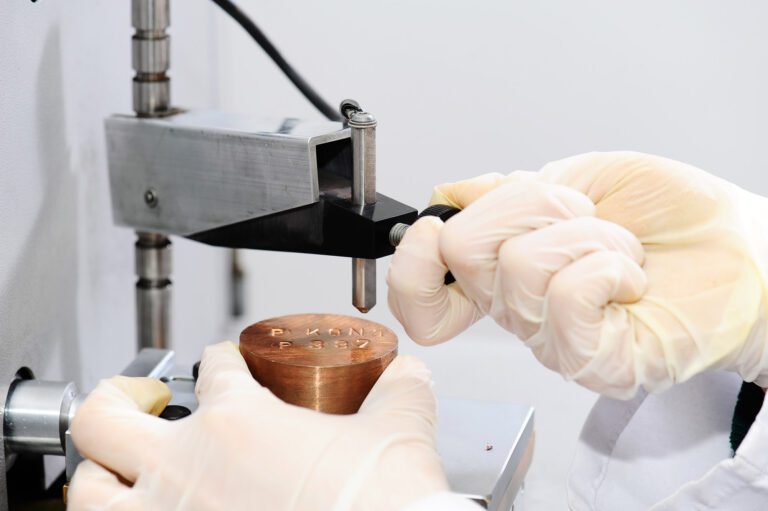
Metallurgical Testing Services
What does ISO 17025 accredited metallurgical testing from Qualimet cover? Metallurgical testing and material verification need proof from…
Learn more about Metallurgical Testing Services ▸